Real-Time Healthcare Platform Ecosystem
Architected and implemented a scalable real-time healthcare platform, powering 500+ Healthcare Units.
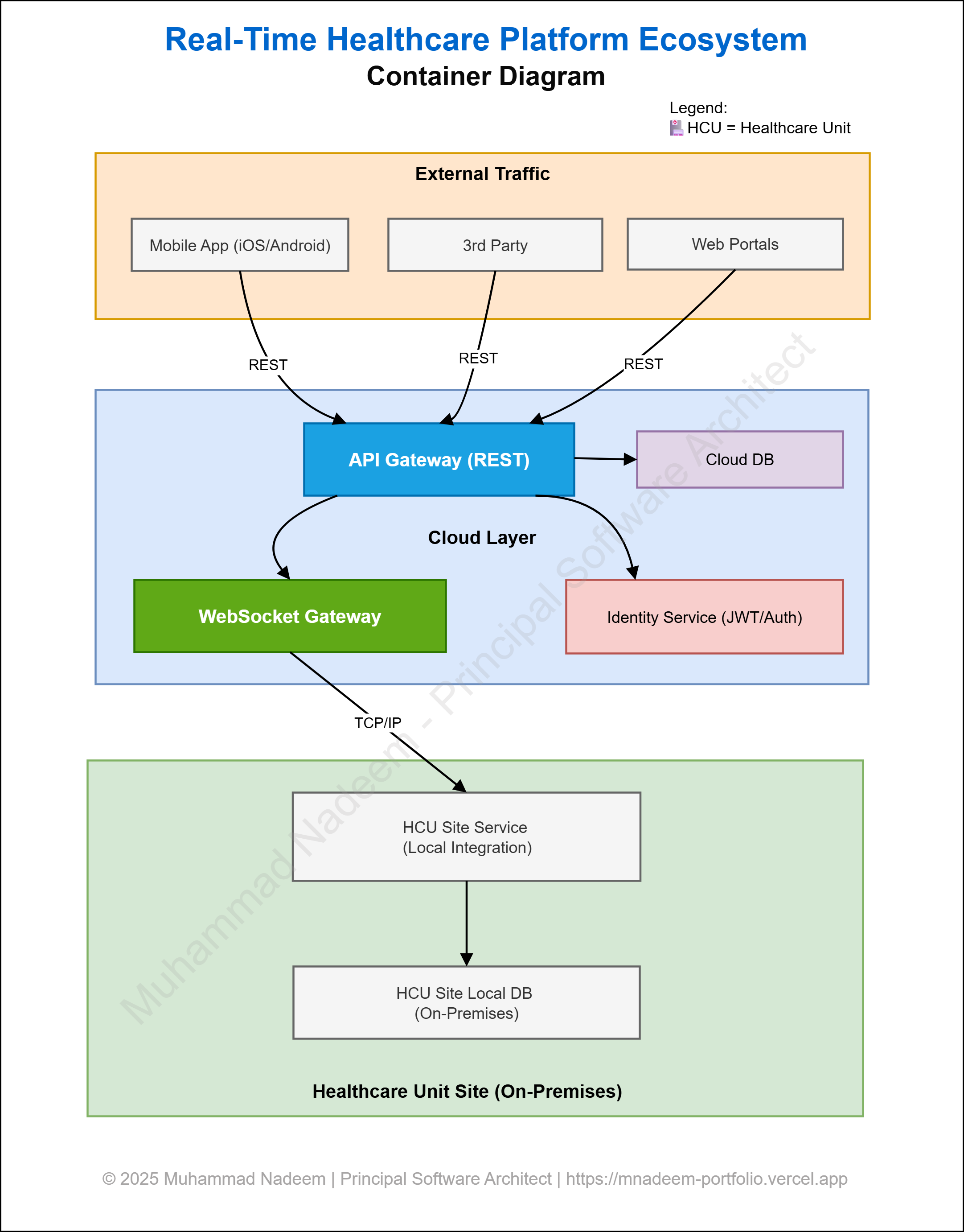
Architected and implemented a scalable real-time healthcare platform using microservices pattern that modernized clinical operations across 500+ Healthcare Units. The solution ensured secure, high-availability data flow for over 5M users worldwide, improving efficiency, reliability, and accessibility of critical healthcare services.
Business Challenge
Healthcare Platforms (Clinics, Practices, Hospitals) traditionally operated in silos — patient records, appointments, and billing data were stored at the clinic level. This caused:
Patients struggling with inconsistent access to records.
Limited ability for mobile apps or third-party integrations to work reliably.
High latency in syncing data between clinics and central systems.
With 500+ Healthcare Units and an average of 10,000 patients per unit (~5M patients in total), the system needed to:
Scale to millions of interactions.
Handle real-time updates (appointments, payments, patient records).
Remain secure and compliant for healthcare data.
High-Level Goal (Vision & Strategy)
The vision was to create a connected healthcare ecosystem where:
Patients interact via mobile apps and portals.
Healthcare systems synchronize in real-time with central services.
Third-party systems can integrate through a controlled and secure interface.
The architectural strategy focused on a dual-gateway model:
API Gateway → managing all external REST/HTTPS traffic.
WebSocket Gateway → enabling persistent, low-latency communication with each healthcare unit.
Architecture Design
High-Level Flow
API Gateway at the portal server handles patient apps, web apps, and third-party requests.
WebSocket Gateway acts as a bridge between the API Gateway and 500+ healthcare units.
Local Services at each healthcare unit maintain persistent WebSocket connections.
Requests are routed to the correct healthcare unit based on patient → healthcare-unit mapping.

Components Interactions
API Gateway
Authentication (JWT) & Authorization.
Traffic routing & throttling.
Partner and mobile app integration.
WebSocket Gateway
Persistent bidirectional connections.
Session management for 500+ healthcare-units.
Routing engine to forward patient-specific requests.
Healthcare Units Services
Windows Service maintaining always-on connection.
Local caching for resilience.
Automatic retries on disconnection.

Detailed Flow (Component View)
Patient request hits API Gateway → authenticated and routed.
Gateway pushes request into WebSocket Gateway → mapped to correct healthcare unit.
Healthcare unit Service processes request, updates DB, and sends real-time response.

Architectural Decisions (ADRs)
API vs WebSocket
REST for stateless, request/response flows.
WebSocket for real-time healthcare-unit synchronization.
Multi-Tenant Routing
Patient requests routed via healthcare-unit ID mapping.
Ensures isolation of each healthcare unit’s traffic.
Resilience & Fault Tolerance
Auto-reconnect policies for healthcare-unit services.
Fallback queues for failed messages.
Security
End-to-end TLS encryption.
JWT for patient identity and healthcare-unit authentication.
Data segregation to meet healthcare compliance.
Key Achievements (Business Impact)
The new architecture delivered:
5M+ users served seamlessly across 500+ healthcare-units.
Real-time communication between patients and healthcare units (appointments, billing, medical history).
Enabled mobile-first experience for patients.
Trusted by business owners due to reliability and scalability.
Created foundation for future services (tele-health, AI-driven patient engagement).